


Blog post #1 24-Hour Media Diet: Spotting Misinformation
5:30 am: I woke up and checked Snapchat. I haven’t posted much on there in years; it’s just a force of habit at this point. After that, I checked my email for updates on the packages I ordered a week ago. I open Twitter and see a few posts about the new Dune movie, and a post of an interview with Billionaire Marc Andreessen saying he has zero introspection, and he goes on about how it’s a modern invention, which I believe is a crazy take.
6:00 am: After getting ready for work and while enjoying my coffee, I open TikTok. I watch a video from one of my favorite creators, Dan McClellan, a scholar of the Bible, who discusses why there is no monotheism in the Christian Bible. His content is very informative.
7:26 am: After getting to work, I sit in my car for 25 minutes since I don’t have to report until 08:00. During this time, I open TikTok again and scroll for the whole 25 minutes. None of the videos had any significance, as most were just brainrot.
8:47 am: I check my email again, then start reading some assigned readings.
9:15 am: I open YouTube on my phone and start a video from the creator iammrbeat, where he goes over every time the United States overthrew a foreign government.
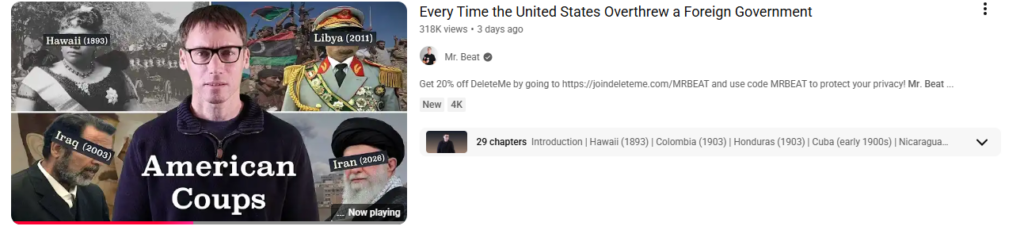
Screenshot of the Mr. Beat video
9:53 am: I start another video. This one is a video essay on the video game Death Stranding from the creator Monty Zander.
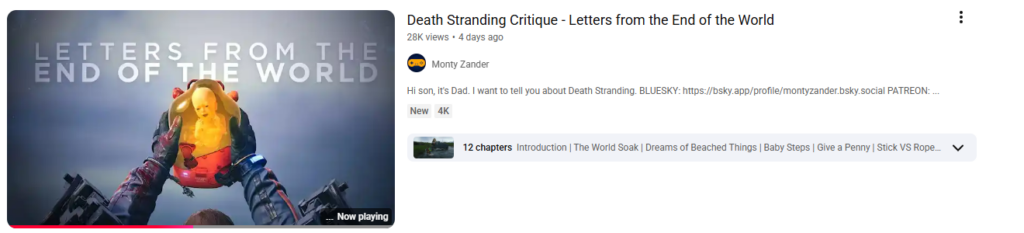
Screenshot of Monty Zander video.
12:24 pm: During lunch, I doom scroll TikTok some more. I then ran across a video from another creator I like, Dr. Dakotah Tyler, an Astrophysicist. In this video, he’s talking about quantum mechanics and the observer effect. I’m no Astrophysicist, so there’s a lot that goes over my head, but he is able to explain a lot in a digestible way.
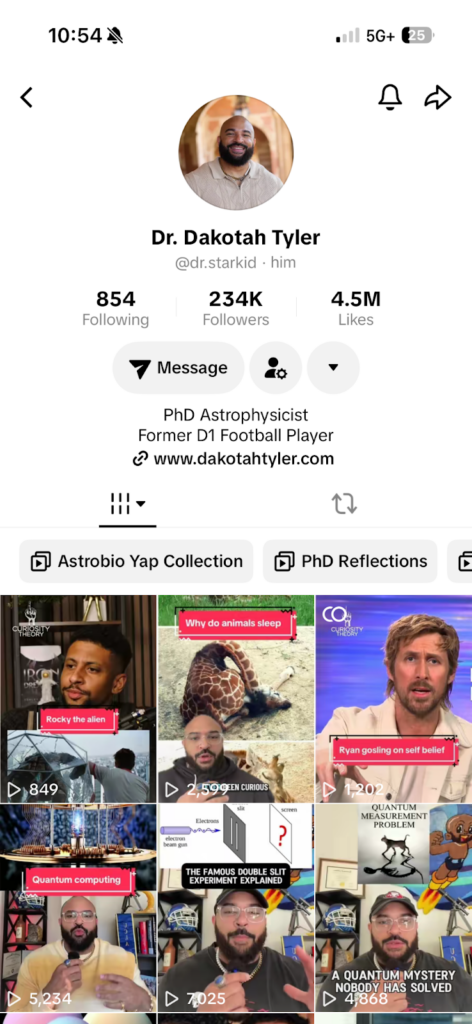
Screenshot of Dr. Tyler’s page.
1:45 pm: Following my lunch break, I read an article from the New York Times, “Diagramming the Last Blows to Iran’s Leadership.” Then, I read another quick article on CNN about the USS Tripoli steaming towards the Middle East from Japan.
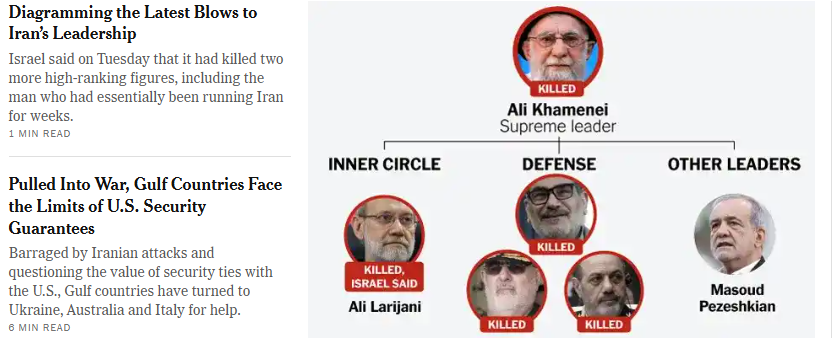
Link to the Times article:

Link to the CNN article:
2:50 pm: Check my email again.
5:43: After getting home from the gym and walking the dogs, I doom scroll TikTok some more. I came across a CNN video of Press Secretary Karoline Leavitt speaking on why other countries should and are obligated to safeguard ships passing through the Straits of Hormuz, as they are benefiting greatly from the US military taking out Iranian leadership who posed a threat to U.S. allies and partners in the region and to Europe. She continued, saying the President is absolutely right to call on countries to do more to reopen the Straits of Hormuz.
I, being an American who consumes mostly American media and news, find it easy to stay within that bubble of information and not branch out to see how the rest of the world views things. I do try to read/watch reputable international news outlets and organizations’ sources; the most common ones are BBC and Al Jazeera. After watching the video, this line of thinking led me to simply Google the question “Does Iran have the kinetic ability to threaten Europe?” I ended up finding the website for the European Centre for Counterterrorism (ECCI) Organization, based in Germany and the Netherlands. In their report, they detail Iran’s military capabilities, in which they would see the use of long-range ballistic missiles, drones, and cruise missiles; all able to reach Europe. But on the other hand, they express how they would counter such threats if faced with them through a multi-layered detection and interception network, counter drone systems, and alliances for non-NATO members. The report also warns that terrorism/proxy attacks and cyber attacks on critical infrastructure can be used as an alternative to direct military actions.
A link to the ECCI website:
I do agree with the reporting for the ECCI that Iran poses a threat to them if Iran chooses to. If we are to believe what President Trump and Secretary of Defense Pete Hegseth are telling the world, that Iran’s military capabilities are degraded and that they have no air defenses, no air force, no navy, their missiles, missile launchers, and drones are being destroyed, and missile launches are down 90%. It seems at this point the threat Iran poses to America’s allies in the region and to Europe is diminishing by the day, and America has it under control.
I really enjoyed looking for and finding context for what the Press Secretary was using as justification for European involvement in a “war” that the American government started without coordinating with European allies.
6:10 pm: I doom-scrolled TikTok for the next hour, then checked my e-mail.
7:15 pm: I set my phone aside and didn’t check social media the rest of the night. I like to “unplug” before bed to clear my mind.
I like to believe that most of the information I consume throughout the day comes from credible, reliable sources. Most of the content creators I watch on TikTok and YouTube are certified educators who use credible sources in their work and collaborate with other certified educators or professionals in their fields. In other news outlets such as Politico,PBS, Forbes, Associated Press, and Reuters. The New York Times and CNN were just what I was feeling today. I honestly don’t do a lot of fact checking when reading articles from those news organizations, as they are reputable and make mistakes, and far and few between, but I know nothing is perfect. I have noticed that most of my fact checking and need for added context comes from seeing a random TikTok video of a random person speaking about a subject for only a minute or so. This might be because the platform TikTok prioritized and incentivized short form content, leading content creators to leave out details just to get a story out that’s easy to “follow” and “digest”. In other YouTube videos I watch, the creators make it very clear that they are expressing opinions, NOT facts.
Blog post #2 Evaluating Misinformation education tools
On Rumor Guard, the website presents news, topics, and events that have been circulating on the internet over the last few days. They detail whether new, viral information, or presented topics are likely to be truthful. They make their determinations by using what they call “The 5 Factors” as tools. These tools are a subject’s authenticity, source, evidence, context, and reasoning. Rumor Guard starts by verifying the authenticity of the presented information. First, they explain what misinformation is, why misinformation is shared, the difference between misinformation and disinformation, the different types of misinformation, commonly used phrases and patterns, and the best ways to combat misinformation. Rumor Guard’s second factor, “Source,” goes over how to check where the initial information is coming from, teaching how bias affects information being presented, and the importance of journalism, with standards such as fairness in reporting, accuracy, and transparency being the main priorities that lead to information closer to the truth being presented. The third factor Rumor Guard has is “Evidence,” which teaches skills in how to refine information searches in Google, the ways evidence can be manipulated to present a preferred story, and they also teach the skill of “lateral reading,” where you compare the information you’re reading with other sources that speak on where you’re getting your information from. I didn’t realize that I do lateral reading almost every time I read. It’s good that I finally have a name for the thing I was doing. The four factors are Context, where Rumor Guard teaches that context can be restricted or removed through doctored photos, videos cut at a certain point, and data presented in a false way to push a certain narrative on a topic. The skills taught to combat this include reverse image search, more advanced lateral reading, and the use of web archives. Finally, the Rumor Guards factor of Reasoning. This factor teaches people how to identify commonly used logical fallacies used in misinformation, such as Ad homines, the slippery slope fallacy, false dilemmas, straw mans, and False equivalences, and describes them. Rumor Guard provides lessons for each factor to help you apply what you just learned, which I find very helpful, as it asks interactive questions throughout the lessons.
The sources provided by Rumor Guard were exceptional in combination with their lessons:
A link to tutorial provided by Rumor Guard on how lateral read when checking for authenticity, evidence, and context:

A more in depth look on the topic of Misinformation.
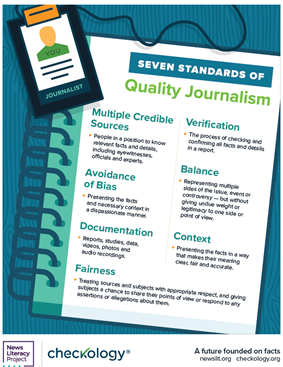
A guide provided by Rumor guard on the seven standards of Quality Journalism.
I started playing the harmony square game, where I found myself on the creation end of misinformation. The games take the form of sowing discontent and chaos in a small town through trolling, emotional manipulation, false amplification, and escalation. Throughout the game, I’m instructed to cause confusion, distrust, and fear by making false claims with no basis in reality, making emotionally charged statements to elicit a reaction from people, amplifying these false claims and statements to show more perceived support than I do, and pushing people to escalate their actions in my favor. We always talk about how and why misinformation and disinformation are created, but it is informative to be on the end that creates it. You can really get into the mindset of how easy it is to just say anything without any proof. On the other hand, since I have now seen how misinformation and disinformation can be created and spread, I know how to identify them better and either combat them or disengage from them. I believe the game also shows how misinformation/disinformation can be spread by anyone and everyone is susceptible to the belief of false information, no matter age, race, financial status , sex, or religion. Continuing education is needed for media literacy if you want to continue combating misinformation/ disinformation.

One response I post to get an emotional response out of Joanna and Harry.
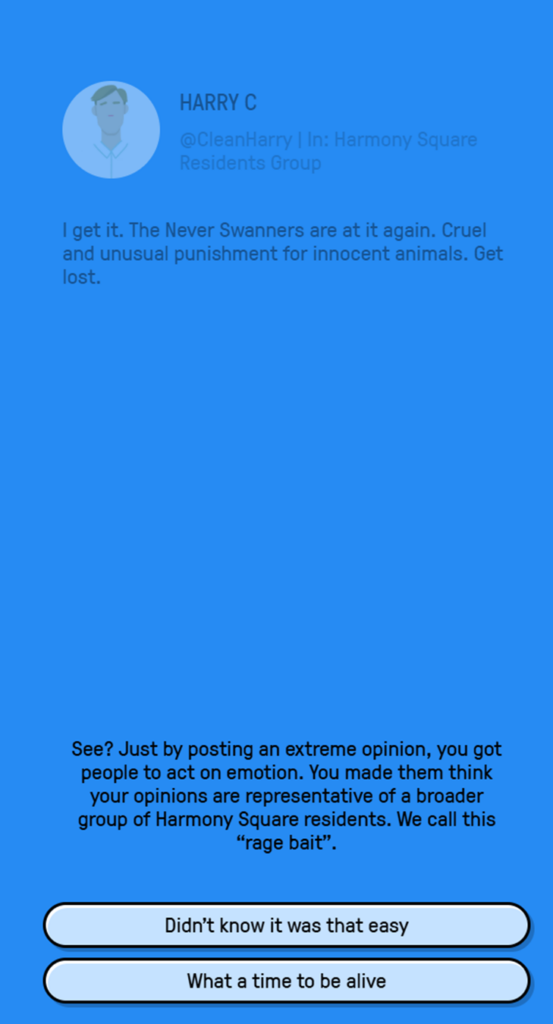
A successful case of “rage bait” in action. I was able to get Harry to act emotionally.
Blog post #3
Today started like any other. I logged in to my computer and started knocking out my daily tasks. Striking up small talk with a co-worker I share my office with, my coworker told me that the federal government is now going to have ICE at the graduations of Marines passing bootcamp to arrest undocumented immigrants. I asked her where she got that information, and she said, “Threads.” I asked if they could send the post to me, which she did.
The post was made on “Threads,” which is an app run by Meta similar to “X” that is attached to Instagram. The post makes the claim that “The-Vance administration is sending ICE to arrest the families of new Marines at their graduation,” with an NBC link attached. I noticed that the text the poster paired with the link could elicit an emotional response, leading someone not to even want to read the attached article.
The evaluation of this claim is important as it could negatively affect my fellow service members by causing mental and emotional distress to them as they think their family members might be targeted by the current administration, causing doubt and distrust for those appointed over them, issuing lawful orders.
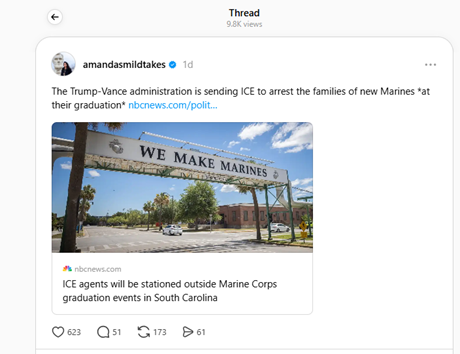
The first red flag noticed was the post just made a very broad claim that the current was sending ICE to Marine Corps graduates to arrest families of service members graduating. The second was the poster claiming ICE is going to be sent to make an arrest, as the article that they link to from NBC states ICE will be stationed outside the Marine Corps graduation. NBC wasn’t making the claim that ICE is going down to solely arrest people. I’m aware that ICE does have the capability to make arrests. I noticed that the text the poster paired with the link could elicit an emotional response, leading someone not to even want to read the attached article.
The first step I take is reading the article provided in the post from NBC.
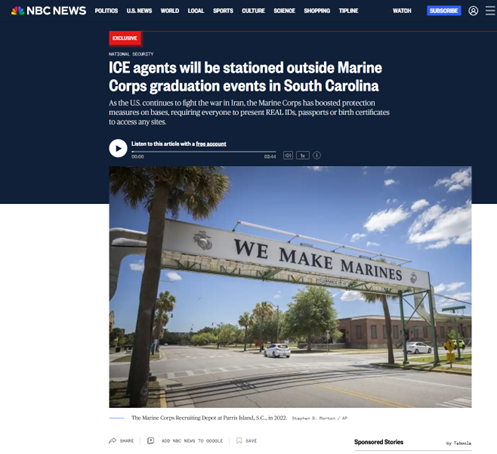
The biggest takeaways from this article are that it makes clear that ICE will be stationed outside the graduation to “identify whether any of their family members are undocumented, according to the Marine Corps. This is due to the Marine Corps increasing its force protection measures. I then went to the Marine Corps website to confirm the increase in its force protection and to confirm the presence of federal law enforcement.

https://www.mcrdpi.marines.mil
I then went to the Marine Corps website to confirm the increase in its force protection and to confirm the presence of federal law enforcement. The statement in the red banner is as follows: “Due to increased force protection measures and to expedite enhanced base access procedures, federal law enforcement personnel will be present at installation access points during Recruit Family and Graduation Days.”
I checked the Marine Corps Times for additional information on the matter.
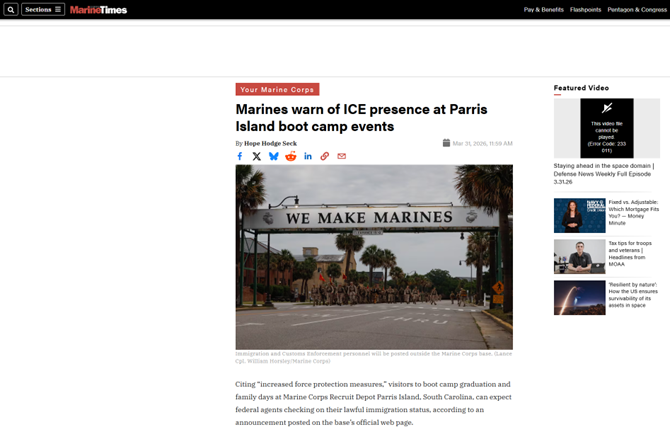
Marine Corps Times did not provide any new information; the article mainly cited the NBC article and the official Marine Corps websites above.
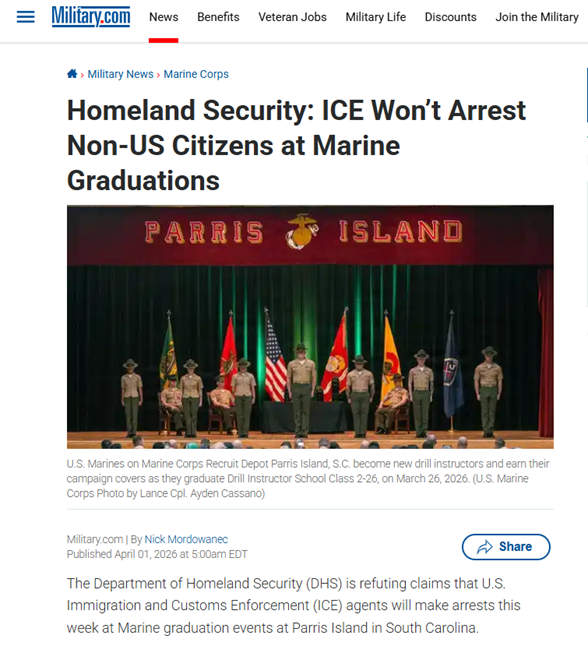
The last website I went to was military.com. The author stated that “The Department of Homeland Security (DHS) is refuting claims that U.S. Immigration and Customs Enforcement (ICE) agents will make arrests this week at Marine graduation events at Parris Island in South Carolina.” DHS rebuttals were made on the social media platform “X”.
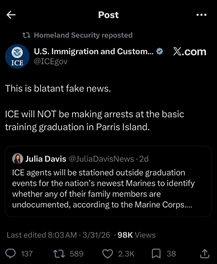
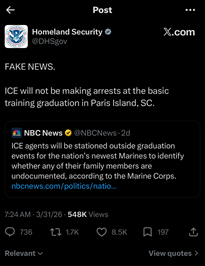
Post 1: https://x.com/dhsgov/status/2038970780231332160?s=46&t=QeBRH1XtNCmeOOfgTMsptg
Post 2: https://x.com/icegov/status/2038980445757493672?s=46&t=QeBRH1XtNCmeOOfgTMsptg
My final assessment is that the Trump administration is not sending ICE to the Marine Corps graduation in South Carolina to execute the arrest of undocumented immigrants. Information from military, military adjacent, and official government sources indicates that ICE is stationed at Parris Island to expedite base access at the base’s access points. The cause for their presence is due to the Marine Corps increasing its force protection measures based on an increase in potential threats stemming from the war in Iran. I believe others should follow steps similar to the ones I took in order to find additional context for claims made on social media.
Blog #4
For this assignment, I looked up my phone’s screen time to see which social media platform I use the most, and it turned out to be “X”, formerly known as “Twitter” and “TikTok”. With that information, start by going to the “Xs” rules and policies section on their website: https://help.x.com/en/rules-and-policies#platform-integrity-and-authenticity. From there, a link to their policy on platform integrity and authenticity is highlighted in blue. In this section, “X” makes it very clear that “You may not engage in inauthentic activity that undermines the integrity of X.” Throughout the page, they outline what “inauthentic activity” is, but never mention the production or distribution of misinformation. They explain what they consider inauthentic accounts: “Accounts on X must be authentic. Under this policy, you may not create, operate, or mass-register accounts that are not legitimate, genuine and transparent as to their source, identity, and popularity.” They include “unauthorized automation” (a.k.a. Bots), “Fake personas” (accounts claiming to be a different person with the use of AI photos, stockin images and stolen bios for the purpose to deceive others.), and “impersonation” (accounts claiming to be a person, group, or organization for the purpose to deceive others.) “X” claim these actions are considered inauthentic accounts that could result in account suspensions, profile modifications, temporary loss of access to X features or products, restricting reach (restricting likes, replies, reposts, quote posts, bookmarks, share, pin to profile, or edit post, and downranking the post in replies.), Denylisting URLs and Anti-spam challenges. In my research about “X” methods to combat misinformation and disinformation I came across a media section on Cornell University called “Tip Sheets” where “Cornell faculty members and experts weigh in on current events.” https://news.cornell.edu/media-relations/tip-sheets in this there was a quick excerpt about “Xs” current efforts to combat disinformation being shared related to the ongoing conflict with the U.S., Israel, and Iran. “X” has gone as far as “temporarily demonetize accounts that share AI-generated war footage without a label.” Demonetize is an effective countermeasure IF the accounts’ goals were to profit off sharing false videos. However, if the accounts’ goals are to sow confusion and chaos, demonetization does little to deter them, as profit was not their goal, and the fake video can still be shared and interacted with, allowing it to spread across the site.
The Anti-Defamation League speaks to the current flaws in “X” ‘s misinformation/disinformation moderation and recommends ways to increase its effectiveness. https://www.adl.org/resources/article/war-rages-x-must-curb-spread-misinformation-and-hate. From my experience with using “X,” I would like to say they hit the nail on the head with addressing the current issues with their moderation, how the lack of robust moderation manifests harmful rhetoric into real world sentiment and physical violence towards vulnerable groups, and what can be done at the moderation level to prevent the harmful rhetoric from spreading. I have seen, and continue to see, misinformation and even disinformation posted to “X” by accounts with thousands, sometimes hundreds of thousands, of impressions on a single post. Most posts have little to no interaction with moderators, and the moderators debunk the information claimed. Even more shocking, the website’s owner would engage with such misinformation in a way that gives it legitimacy. I agree with the ADL’s recommendations for better content flagging, updates to account verification, bringing back “state sponsored media labels,” and not allowing the removal of headlines for new accounts’ content. I feel all these recommendations will enhance the “X” experience and curb the spread of misinformation and disinformation on the site.
I then headed over to TikTok’s “Countering Harmful Misinformation Guide”: https://www.tiktok.com/safety/en/tools-and-guides/harmful-misinformation-guide
From that point, TikTok explains how misinformation can affect people’s safety and health and why they take the steps they do to combat its spread on its platform. Right off the bat, TikTok prohibits misinformation regarding health, elections, climate, change, and “more”. TikTok’s method of moderation uses fact checkers who “assess whether information is true, false, or unverified.” The content is then labeled accordingly. AI-generated content is labeled as such to include unverified content. For content discussing real-world events that tend to change rapidly as more information becomes available, TikTok adds labels to the content, reminding people to check sources on the subject. TikTok also gives a simplified rundown of how to spot misinformation, and some methods are similar to the methods we are taught in this class! On a separate page, https://www.tiktok.com/safety/en/policies-and-engagement/combating-misinformation#GFCP, TikTok explains what misinformation is and how it differs from disinformation. TikTok renews the integrity and authenticity of its moderators involved in its global fact-checking program. The Harvard Kennedy School conducted a survey to determine “How effective are TikTok misinformation debunking videos?” https://misinforeview.hks.harvard.edu/article/how-effective-are-tiktok-misinformation-debunking-videos/. The findings of the study showed that if a person watched a video with misinformation, then watched a video debunking the previous video, people were more likely to believe the debunking video. But if people saw the debunking video out of context, without first seeing the video with misinformation, they would believe the false information. Based on my experience with TikTok, their content moderation is how they explain it, and I do see less misinformation and even less disinformation compared to “X”; some misinformation still slips through the cracks and makes its way to my feed. I rarely see debunking videos right after seeing a video with clear misinformation. TikTok takes the influence of misinformation/disinformation seriously and works to combat it. This can be seen by directly addressing what it is, how it affects people and the world, and explaining what they’re doing to combat it. Whereas I feel “X” does the bare minimum to meet legal obligations and to prevent only the most egregious misinformation/disinformation from being posted.
Final Blog Post
Beware: The Danger of Context Online: A Blog Post for People 50+
You don’t always have to lie to spread false information. Sometimes, the truth is there, but it is twisted. A photo may be old. A quote may be taken out of context. A graph may display just part of the right story. This is known as false or showing a lack of context. It can make a bad argument look good. It can also make a study that makes clear qualifications appear like it’s proof or confirmation. Sometimes it’s difficult to recognize misinformation as it combines the truth with incomplete information.
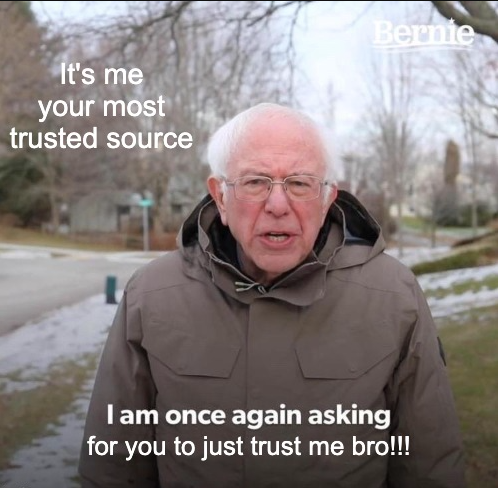
Misinformation tends to rely on people taking the information presented as facts without the receiver doing any research on where the information is coming from.
False Context Is Believable
False context works because it looks serious. The post may include a pie chart, a statistic, or something from a report. These can make the post sound official and credible. But the post may not include who created the chart, how the study was conducted, or what the report said. According to AARP (2026), health posts use strong statements but lack sufficient information to explain the numbers. This can be dangerous for older adults when the subject is health, finances, politics, or family.
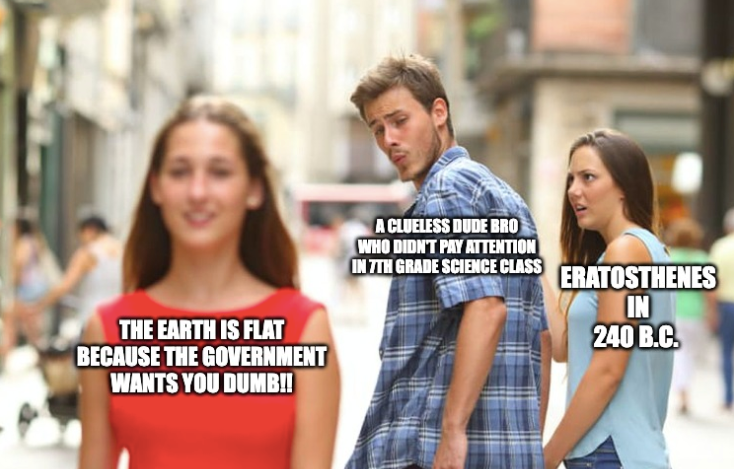
Health and Science posts can generate an emotional response from the viewer and display information that isn’t fully explained even when a claim has been studied or disproven for years, decades, and in this case millennia.
Tactics That Often Target Older Adults
Misinformation posts might be structured to establish trust before they say something false. One tactic is an appeal to authority. A post may claim a medical professional, veteran, professor, priest, or ex-government official supports the claim. The name may be legitimate, but the claim might not be true or accurate. Another tactic is nostalgia. With a post claiming that things were better and cleaner, safer, or more honest in the past, then blaming another group. A third is an emotional headline. Sometimes, headlines include shocking, banned, secret, or finally revealed because they increase fear or anger before people can rationally think about what they are seeing. Shin et al. (2025) demonstrate that emotional clickbait is an effective way for news to attract attention on social media. Engagement bait is another tactic. A post could read, “Share before it is removed,” or “This is patriotic, if you are a true American, share it.” The goal is not truth. It wants more views, likes, and shares.

Most of the time the past that is reminisced about never truly existed to begin with. That tactic is used to just elicit an emotional response from the viewer.
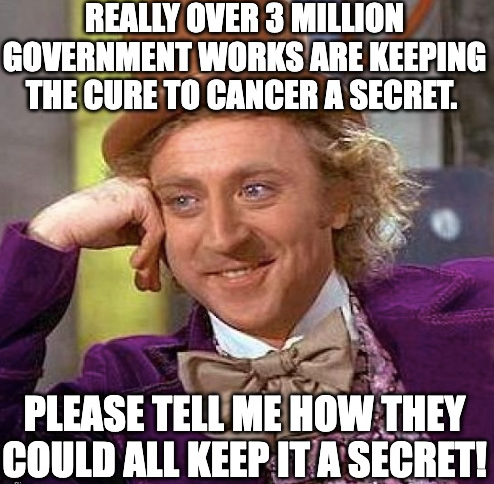
Being presented with information that “someone or some entity doesn’t want you to know!” can generate interest in false information.
Social Media, and the Absence of Context
False context spreads on social media. According to the Pew Research Center, 84% of American adults use YouTube and 71% use Facebook (Gottfried, 2025). They can connect you to your family and to the news. But they can also send scam posts to many people. A video might only show us part of what’s going on. A graph could start at an odd date to exaggerate a rise. A photo may be misdated or from a different country. If it looks like something you’ve seen and from a friend, you may think it’s safe.
Figure 1. Common social media platforms used by U.S. adults, based on Pew Research Center data (Gottfried, 2025).
Private Messages Make Correction Harder
Falsehoods don’t just travel public streams. They also go out via text messages, WhatsApp, Facebook Messenger, and family groups. Private messages feel personal. We can trust a message from a cousin or close friend, rather than in public. According to Lee and Fussell (2025), it’s difficult to challenge misinformation in private groups because of family dynamics and group norms. Someone might be silent to avoid upsetting someone. This can allow the misinformation to continue spreading. Context also disappears in private messages. You can receive a forwarded picture without the source, date, or URL.
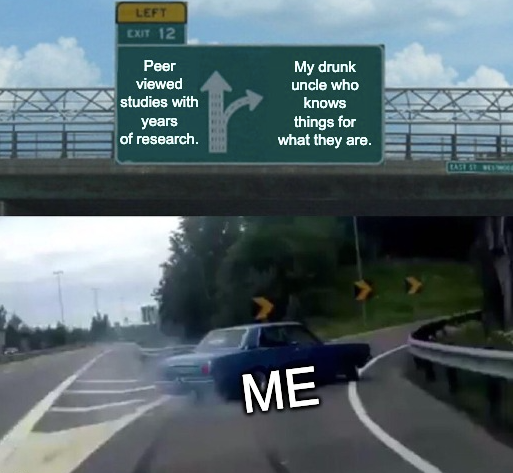
It makes it harder to dissuade someone when the information they are receiving is from a family member.
Side-by-Side Examples: How Full Context Changes Meaning
| Missing-context post | Full context | Safer response |
| “Crime is up 200% in this town.” | The graph starts during a rare low month. The full yearly rate is almost unchanged. | Check the full date range and local crime report. |
| “The doctor says this herb cures diabetes.” | The doctor discussed early lab research. No human trial proved a cure. | Ask for the full study and talk with a licensed clinician. |
| “Politician admits plan will hurt seniors.” | The quote was cut from a longer answer about trade-offs and protections. | Find the full video or transcript before sharing. |
Checking Studies Before Trusting a Claim
Many posts misuse research. A post might say, “New research shows this pill will stop memory loss”. A savvy reader should pause. First question: Was the study on people, animals, or cells in the lab? The second question is about the number of people. Is the study based on 18 people, or 18000? The third question is whether the study found an association or causality. For instance, people who drink tea may be healthier for a number of reasons other than tea. The fourth question is whether the study was refereed and funded. Older people can find health information online difficult to digest because of uneven health and technology skills, says Zhang (2025). Research methods are important because a poor method can result in a misleading headline.
Figure 2. Digital literacy training improved fake-news detection among older adults (Moore & Hancock, 2022).
How to Respond Without Fight
A false post should not escalate to a debate. Polite is better than embarrassing. Such a reply might begin with respect, such as, “That is a disturbing statement, so let’s see the whole article.” Then the person can include a link from a health department, university, large news publications or fact-checking website. If it’s a family discussion, direct messaging may be best. The person can explain that the aim is to help, not criticise. Baines et al. (2025) found that many older adults already attempt to fact-check and read comments about suspicious information. So, we can correct using techniques people might already be aware of.
Reporting and Replacing Bad Information
Do not discuss certain posts. Most social media sites have a report button beside the post, message, or video. Clicking will give you options such as misinformation, scam, fraud, or misleading health information. It may not cause the post to disappear, but it sends a message. A better option is to repost the best information. For health information, the Centers for Disease Control and Prevention, the Food and Drug Administration, a doctor, or a research article is better than a TikTok star. For financial claims, a bank, the Federal Trade Commission, or AARP fraud information is better than your friend’s email.
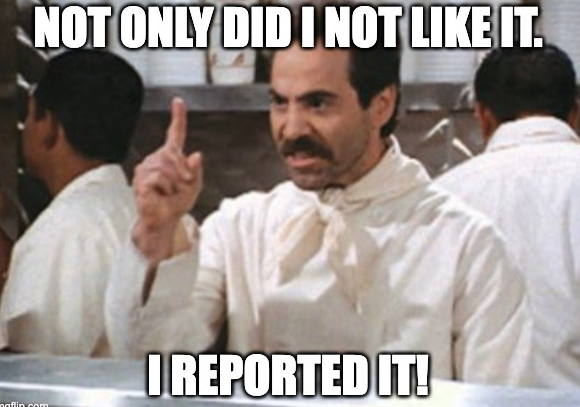
Reporting misinformation is a good way to combat its spread.
Digital Literacy Can Be Learned
Suppose you feel you are not digitally literate. It is about practice. Moore and Hancock (2022) showed that a brief lesson on digital literacy skills increased older adults’ fake-news detection ability from 64% to 85%. The lesson taught things like checking the source and switching documents. This is also known as vertical reading. This involves not staying on the post and looking elsewhere. You can also do an image search to check if an image has been published previously. This can help prevent a lie from spreading.

Disapproving misinformation though increasing your digital literacy can be hard at times but once learned you become a better person because of it.
Conclusion
False context is bad because it can be hidden within a fact. A statistic, quote, graph, or image can be factually correct but not biologically true. Seniors deserve to be given answers, not scapegoated. We should all ask questions like: What’s missing? The date, source, complete quote, full chart, methodology, and the original graphic are important. When someone appeals to authority, nostalgia, fear, or urgency to pass it on, be cautious. A gentle correction, a link to the source, and a report can save family, health, finances, and human trust.
Combating and not falling for misinformation may not be easy but it is simple.
References
Baines, A., Hargittai, E., & Palfrey, J. (2025). Older adults’ response strategies to misinformation on social media. Social Media + Society. https://journals.sagepub.com/doi/10.1177/20563051251386360
Blaß, J. S. (2026). Data in the context of misinformation: A scoping review. Journalism & Mass Communication Quarterly. https://journals.sagepub.com/doi/10.1177/10776990251410602
Bragazzi, N. L., & Garbarino, S. (2024). Understanding and combating misinformation: An evolutionary perspective. JMIR Infodemiology. https://www.sciencedirect.com/org/science/article/pii/S2564189124000331
Moore, R. C., & Hancock, J. T. (2022). A digital media literacy intervention for older adults improves resilience to fake news. Scientific Reports, 12, Article 6008. https://doi.org/10.1038/s41598-022-08437-0
Pew Research Center. (2025). Americans’ social media use 2025. https://www.pewresearch.org/internet/2025/11/20/americans-social-media-use-2025/
Xu, G. (2025). Misinformation dissemination on social media: Key research themes and evolutionary paths between 2013 and 2023. Humanities and Social Sciences Communications. https://www.nature.com/articles/s41599-025-06067-1
Zhang, C. (2025). Social media and eHealth literacy among older adults: Systematic literature review. Journal of Medical Internet Research, 27, e66058. https://www.jmir.org/2025/1/e66058